Digital Board for Higher Education
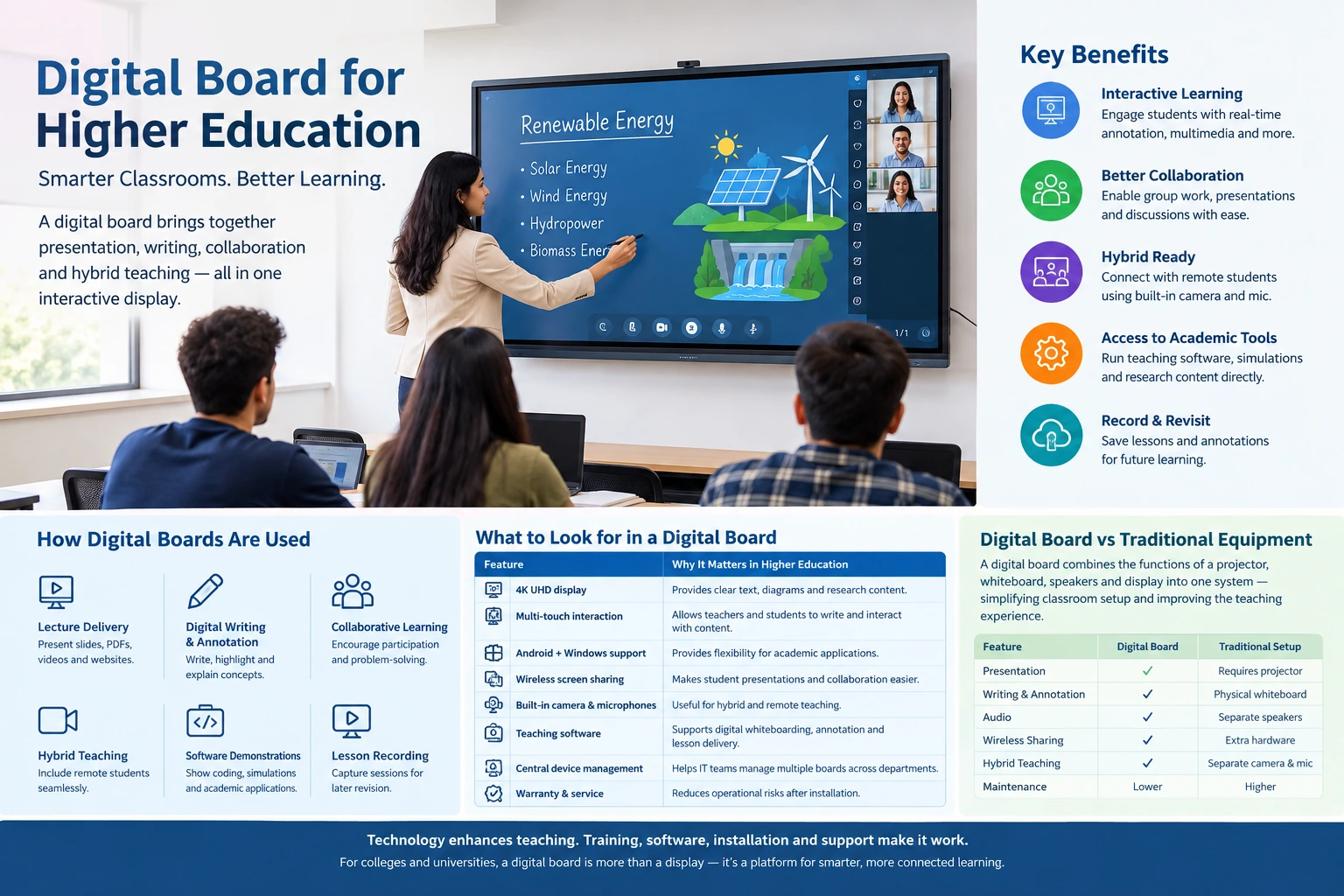
A digital board for higher education is an interactive display designed to support teaching, presentations, collaboration and digital learning in colleges and universities. Unlike a conventional whiteboard or projector, a modern digital board combines a large high-resolution touchscreen with digital writing, multimedia playback, internet connectivity, classroom software and, on selected models, AI and hybrid-learning features.
In higher education, digital boards can be used across engineering, medicine, management, science, law, computer applications and other academic disciplines. Faculty can present lectures, annotate presentations, explain diagrams, display research material, solve equations and demonstrate software directly on the screen.
How Digital Boards Are Used in Colleges and Universities
Digital boards can support several classroom activities:
- Lecture delivery: Faculty can present PowerPoint files, PDFs, videos, websites and other digital resources directly from the board.
- Digital writing and annotation: Teachers can write over presentations, diagrams and documents while explaining concepts.
- Collaborative learning: Students can participate in problem-solving, presentations and interactive classroom activities.
- Hybrid teaching: Digital boards with integrated cameras and microphones can support sessions involving students attending remotely.
- Software demonstrations: Faculty can demonstrate coding, engineering applications, simulations and other academic software on a large display.
- Lesson recording: Some classroom platforms allow teachers to record lessons and digital annotations for later revision.
What Should Colleges Consider When Choosing a Digital Board?
The right digital board depends on classroom size, teaching requirements and the institution's existing technology infrastructure. Colleges should evaluate more than screen size and price.
| Feature | |
| 4K UHD display | Provides clear text, diagrams, presentations and research content |
| Multi-touch interaction | Allows teachers and students to write and interact with content |
| Android + Windows support | Provides flexibility for classroom applications and academic software |
| Wireless screen sharing | Makes student presentations and collaborative activities easier |
| Built-in camera & microphones | Useful for hybrid and remote teaching |
| Teaching software | Supports digital whiteboarding, annotation and lesson delivery |
| Central device management | Helps IT teams manage multiple boards across departments |
| Warranty & service | Reduces operational risks after installation |
Digital Board vs Traditional Teaching Equipment
For colleges and universities, a digital board can bring several classroom functions into a single system. Instead of separately managing a projector, projection surface, speakers and physical whiteboard, institutions can use an interactive display for presentation, writing, multimedia and collaboration.
However, technology alone does not improve teaching. Faculty training, software usability, installation quality and after-sales support are equally important when implementing digital boards across higher-education classrooms.
For Indian colleges and universities evaluating digital classroom technology, an interactive digital board can be considered as part of a broader smart classroom solution, particularly where institutions want to combine teaching, collaboration, hybrid learning and digital content on one platform.
No comments yet. Start the conversation!